Tuesday, 16 October 2018

Software that guesses which algorithm saved a given JPEG


Some time ago, I found a piece of software that would provide a good guess on the software/algorithm used to save a JPEG.


If I recall correctly, it would analyze something like the compression artifacts and compare it against a known database. The result allowed to know if the JPEG was a result of specific cameras (ie: Canon Powershot A560) or image processing software (ie: Photoshop CS 8.0). Note that it would not read exif information.


What software was this?


Is it still around?


Answer


Try JPEGSnoop:


JPEGsnoop is a detailed JPEG image decoder and analysis tool. It reports all image metadata and can even help identify if an image has been edited.


As explained on the JPEGSnoop webpage:


One of the latest features in JPEGsnoop is an internal database that compares an image against a large number of compression signatures. JPEGsnoop reports what digital camera or software was likely used to generate the image.


Monday, 15 October 2018

usb - EOS Utility does not detect my 550D


I have a Canon EOS 550D.


EOS Utility recognizes the camera only sporadically. When I connect it Windows opens the camera page from Devices in the Control Panel, and there is memory usage, battery charge etc. However, when I start EOS Utility, it does not offer any camera related options, only "Monitor Folder" is enabled. I have now tried connecting it with the original cable to each of the 12 USB ports I have on my computer, without any success. Sometimes upon connecting it, it just works, but most of the time it won't. I have also tried running Utility as admin, no difference.


I have googled for this problem, but found no real solution.


EOS Utility version is 2.11.4.0


I don't know if it is important, but I have Windows 8 RC.


UPDATE: Same problem occurs on final, activated version of Windows 8.


How can I best utilize a point-and-shoot for concert photography?


I'd like to shoot live concert photos with my camera. Are there ideal settings that I should be looking for with a small-sensor point-and-shoot that enable me to have a better chance to get good photos from my efforts?


I have a Panasonic Lumix DMC-TZ10.


bokeh - How does a teleconverter affect depth of field?


I'm aware that a teleconverter will reduce the amount of light reaching the film or sensor in a camera, and as such you hear people banding around things like "With a 2x teleconverter this 300mm f/2.8 becomes a 600mm f/5.6".


Given the aperture isn't physically any different, I wonder how that affects depth of field (and associated effects like bokeh). It would make sense that the depth of field remains the same, and the image is merely cropped.


Is it just another one of these things that people say, that may be convenient for exposure calculations, or is there actually a change in the image produced?


Answer


TL;DR version: Teleconverters don't affect depth of field at any given distance. They literally transform your 300 f/2.8 lens into a 600 f/5.6 lens. Any 600 f/5.6 lens, teleconverted or not, will have the same depth of field as a 300 f/2.8 lens.


There's a lot of confusion about the relationship between depth of field, aperture, f-stop, and focal length. In reality, it's all very simple:


Depth of field is determined by focal distance and the apparent size of the front element of the lens.


By apparent diameter, I mean the width of the area of the front element that isn't blocked by the aperture.


You can actually see how big this apparent diameter is, by looking at the front of a lens while it's detached and the aperture is held open.


The relationship between f-stop, focal length, and apparent lens diameter is as follows:


(Size of aperture in mm) = (Focal length in mm) ÷ (f-stop)


For example:


  • The apparent diameter of a 210mm lens set to f/4.5 is 47mm,


  • The apparent diameter of a 70mm lens set to f/4.5 is 15.5mm,

  • The apparent diameter of a 70mm lens set to f/8 is 8.75mm,

  • And the apparent diameter of an 18mm lens set to f/3.5 is a paltry 5.1mm.


Now, back to depth of field. Depth of field is the distance in front of and behind the focused distance that is still "acceptably" in focus. Since the level of acceptable blur differs from person to person, a better way to analyze depth of field is through the circle of confusion.


Here's a handy picture from the Wikipedia page on Circle of Confusion: A diagram explaining the circle of confusion
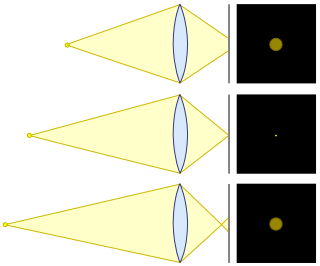

The circle of confusion is the area on the sensor that is hit by light from a single point. If you're in front of or behind the plane of focus, then your circle of confusion gets bigger. At the plane of focus, the circle of confusion is (ideally, but never in practice) zero.


How quickly your circle of confusion grows as you move away from the plane of focus is a factor of one thing only: The angle between the widest converging lines (the edge of your apparent lens size). Now, this means a few things:


  • If you are focused 10 times further away, you have to go roughly 10 times further from the plane of focus to get the same change in your circle of confusion


  • Two lenses focused at the same distance, with the same apparent size, will result in the same change in your circle of confusion (and therefore the same depth of field.)


Conversely, this also debunks several commonly held beliefs about depth of field:


  • Two lenses at the same f-stop do not necessarily have the same depth of field. The longer lens will have a shorter depth of field, because it has a bigger apparent size. (Sorry, Matt.)

  • Teleconverters, cropping, and smaller sensors do not have any effect on depth of field at a given apparent size (f-stop and focal length).


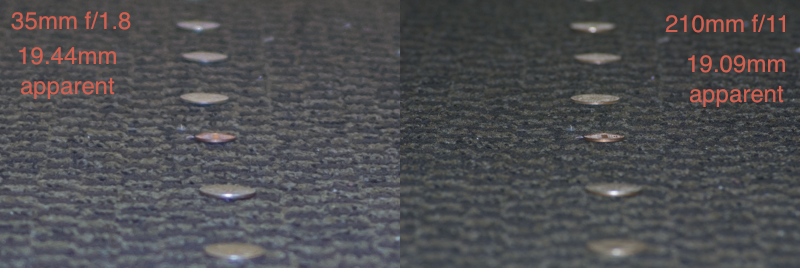
Take two pictures: one with a 35mm f/1.8, and one with a 210mm f/11. Now, crop the 35mm image to have the same field of view as the other image. They will have almost exactly the same depth of field. Here you go: alt text

Sunday, 14 October 2018

canvas - Alternative media for printing photos


The standard way to print photos is on paper, but I'm noticing in particular two alternatives that are starting to make a bit push, namely Metal and Canvas. So, my question is, why would I want to print on any medium besides paper, and what types of prints are suited for these and any other alternative mediums that might exist?


EDIT: I'm looking for something to hang on the wall, so feel free to ignore any kind of merchandise, cake, or whatever else might be around. Thanks!


Answer


Canvas prints, sometimes also called Canvas Giclée, are very similar to traditional pigment on canvas paintings. So any time you're trying to fit into an "old world" type of environment, they are a very attractive option. The traditional stretched option lines up well for framing just like an old painting would, and the gallery wrap options mimmic more modern applications of canvas by painters. Plus the newer "thin wrap" style of canvas gives a smaller and lighter hanging/mounting option, while preserving the traditional canvas look. (In theory I suppose you could say it's comparable to the old masters that glued their canvas to planks of wood before painting them... so we've gone full circle.) I should also note that there are places that will transfer emulsion onto canvas as well, printing on paper, then wet stripping the emulsion layer and bonding it to a layer of canvas.


As ahockley noted, the ink bleed from the printing process can sometimes lower the sharpness of the image, so this shouldn't be used if you have to have an absolutely razor sharp image, especially up close or for a small print size.


Metal prints have a very industrial feel to them. One of the first places I've seen these become popular was in shops and garages of racing folks. When you think about it, they're very similar to a car body panel... thin metal (usually Aluminium) with a layer of image (special dyes instead of paint) covered by top coats of clear protectant (pretty much the same stuff the high end car painters use). In the US, BayPhoto are the masters at this IMHO, I have a few here in the house from them, have seen a number of them, and have sold a couple.


They generally are "ready to hang", you take them out of the box and put them on the wall. No framing, etc needed. Combine that with the very sleek industrial feel and they're quire popular with a lot of folks that don't want the same old same old.


There are a number of finishing options with metal prints, but to me, the "prototypical" example is the high gloss finish. This really gives a huge pop to high contrast images like fireworks, or deeply saturated images.


Another alternative "media" you didn't mention is Acrylic. fotoflōt do these very well. It's kind of like the float mount metal prints above, in that it's a sheet of acrylic with your photo bonded to it and the edges laser cut. They have an additional flair in that the acrylic then is mounted to the wall with magnets. Now, having said all that... it isn't really an alternative media. At best it is alternative mounting/framing/presentation... as it involves printing on traditional emulsions on paper first. Then bonding that to the acrylic. But really, you'd never know it to look at it, and everyone seems to consider it a media. Personally, I don't own any fotoflōts, but the ones I've seen have really looked great, seemingly no mater what the image was. If it looks good printed it will look good mounted that way.


A forth option, and I can't believe I didn't think of it before: duratrans in a lightbox. I believe DPI-SF does the lightboxes at our HQ building, which includes a number of amazing lightbox images. This makes for literally glowing images. I'm not sure exactly what would be the ideal image profile for this, but lots of stuff seems to look good so far. (There's another lightbox at HQ that's even better than those three, but I can't seem to find a shot of it online.)


Saturday, 13 October 2018

business - How to accurately / competitively price prints when digital images are already paid for?


My wife is a wedding and fashion photographer (as well as some family and maternity). We've been traditionally giving our High Res images as a part of the package price to our customers. Now that we've started using SmugMug for our client gallery, we're thinking about offering prints as well.


The problem here is that because we've been giving the digital copies for free, and because a client could take those digital copies to the cheap spot to get them printed... we're unsure where to "start" when it comes to print costs.


One thing we are considering doing is taking one of our images and getting it printed at SmugMug in "Gloss" "Luster" and "Metallic" and then also get it printed at Wal*Mart, Costco, London Drugs, Blacks, etc. This way we'll be able to show the client the difference in quality.


My question is, how can we go about pricing our images accurately and competitively? We want to be competitive, but we don't want to deter our clients from using a professional print lab over Wal*Mart.


Edit


Though all of the answers and comments thus far are very helpful, I feel the focus is on the fact that the digitals are free. I'm wondering a little more about how to price the prints.


Answer


The market is changing. Many people can make their own prints - as it is now nearly trivial to do so with inexpensive-but-excellent 7+ ink home printers - and will look for this option when hiring a photographer. More people know how to operate computers. Photographers, usually the older ones, hate this.


The photographer is tasked with taking the photos. You may wish to choose another person to create the prints. Of course, this goes against the current wedding photography motto (which goes something like "extract as much from your client as you can by instilling in them a fear that this most important day will be ruined if they don't spend enough").


You can find yourself enough clients that will take highres jpegs and do with them as they please. The idea of managing licensing options for wedding photos is too complicated. Commercial photography is one thing, wedding another. A couple wants to make another print for their parents - they should not have to contact the photographer.


The most sincere and transparent way to approach pricing is to ask yourself - would I pay this much for a print? If you say 'no', then reconsider your market and your approach to your clients.


lens - Nikon lenses: to G or not to G?


I am set to buy a 2nd lens to my d7000 kit lens.


I’m close to deciding between the 35 or 50 mm, I will likely go for the f1.4 version and wanted to determine if I would need or appreciate the G (missing aperture ring) or not.


I am ok with setting the aperture on the camera body of my d7000 but feel there is more to this and wanted to dig deeper.


Is it fast and simple to make frequent changes with the G version? Are there any differences in images? Lens build? Quality hardware?


I’m trying to get an idea what to expect from the G version as opposed to the non G version.


Thanks all.


Answer


Since you are using a D7000 which allows you to set the aperture with the camera body, you will be fine. The real disadvantage to a G model lens is that you cannot use them with a manual focus camera because you will have no way to set the aperture. If you can't control the aperture on the camera then the lens will always shoot at the smallest aperture.


There are numerous sources online explaining the shortcomings of the G models, none of which apply to you. One such source is here, which I read to double check and make sure I remembered what I read before :-). Note that it says "G eliminates many features with older cameras." (emphasis added by me).


Hope this helps.


UPDATE:


I should have added more info about the G vs the D lens. I thought you were just asking about whether "G" mattered.


If I were you, I would read this review from cameralabs which actually talks a little about both lenses.


Note that the G model is also AF-S which means that it has the "silent" motor autofocus so it focuses quietly. The G model is also much bigger than the D model. Overall it seems to have better performance (although not in all situations) and I think I've read in multiple places that the bokeh is better on the G model (because it has more aperture blades?).


Why is the front element of a telephoto lens larger than a wide angle lens?

A wide angle lens has a wide angle of view, therefore it would make sense that the front of the lens would also be wide. A telephoto lens ha...